
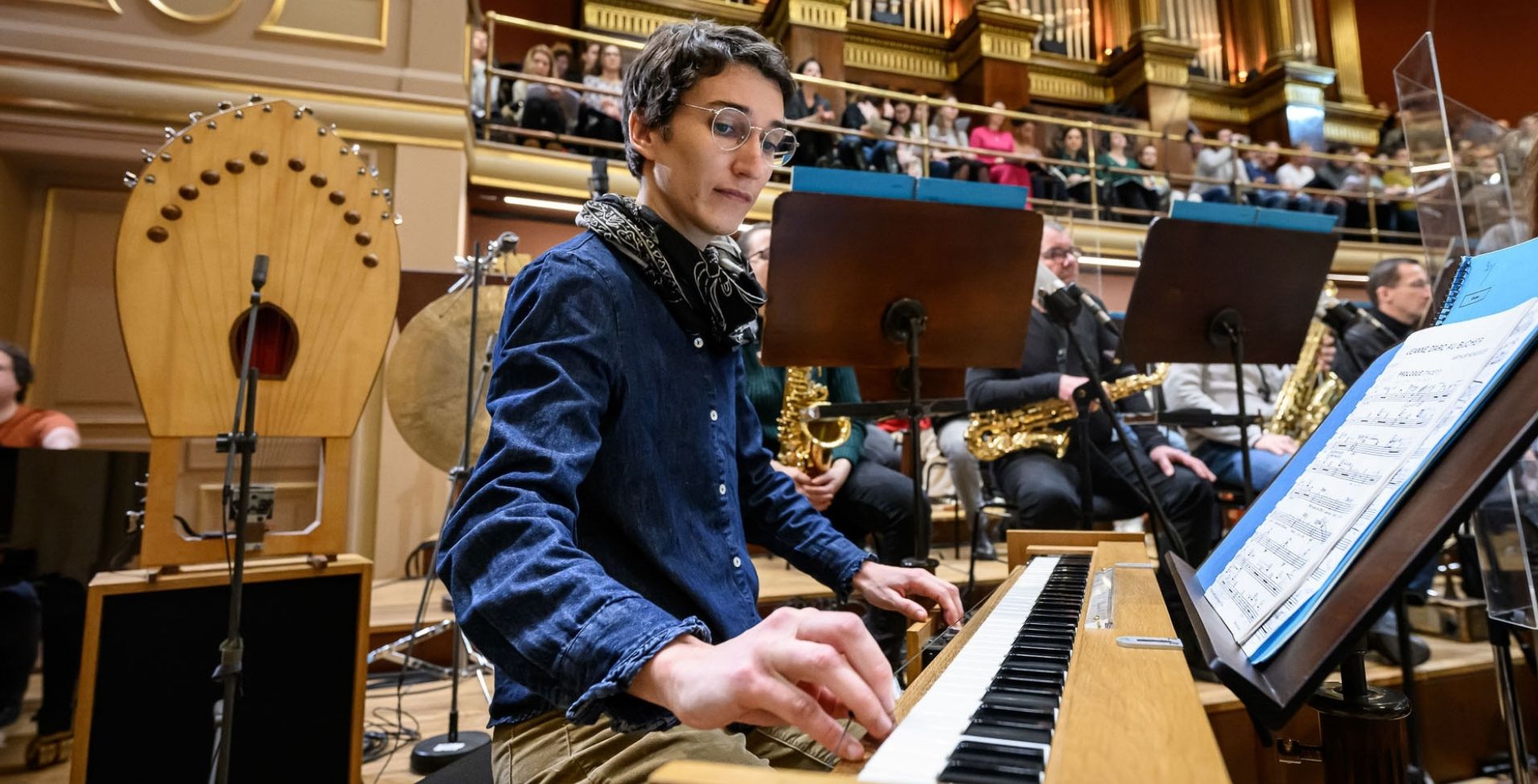
Cécile Lartigau playing the ondes Martenot. Photo credit: Petra Hajská
In our current era of electronic production and digital instruments, orchestral music is often depicted as championing a more ‘traditional’ approach to music, one which relies on classical methods of composition and the production of sound. The ondes Martenot, however, challenges these narratives, blurring the lines between traditional and modern music. The unique and enchanting sound of this nearly 100-year-old electronic instrument has united audiences from all musical backgrounds for decades, forming unlikely connections, and inspiring extraordinary musical works.
Just ask Cécile Lartigau, a leading ondist and champion of the instrument, whose first hand experiences illustrate its universal popularity:
‘I’ve spent an entire Paris–Moscow flight discussing electronics with a Russian mathematician, had a passionate conversation about the music of André Jolivet, Arthur Honegger, and Olivier Messiaen with an Alitalia flight attendant… More recently, a woman in the audience told me she had been waiting since 1959 to hear the ondes Martenot live again, and a young man drove 500 kilometers in an old car to attend one of my concerts, after discovering the instrument by chance on the internet.’
Much like its audience, the instrument’s inventor and namesake, Maurice Martenot, also had interdisciplinary interests. A cellist and radio operator during World War I, Martenot found a musicality in the overlapping tones of military radio oscillators. He then sought to replicate them through an electrical device with the precision and sliding range of a string instrument, as explained by Lartigau:
‘It produces sound by generating electrical oscillations, similar to how a radio works, which are then transformed into audible tones through speakers. What makes it unique is the way it is played: the musician can slide a ring along a wire to control pitch, like a continuous violin glissando, or use a keyboard to play notes more traditionally…This combination of electronic generation and expressive performance gives the instrument its very distinctive, almost magical quality.’
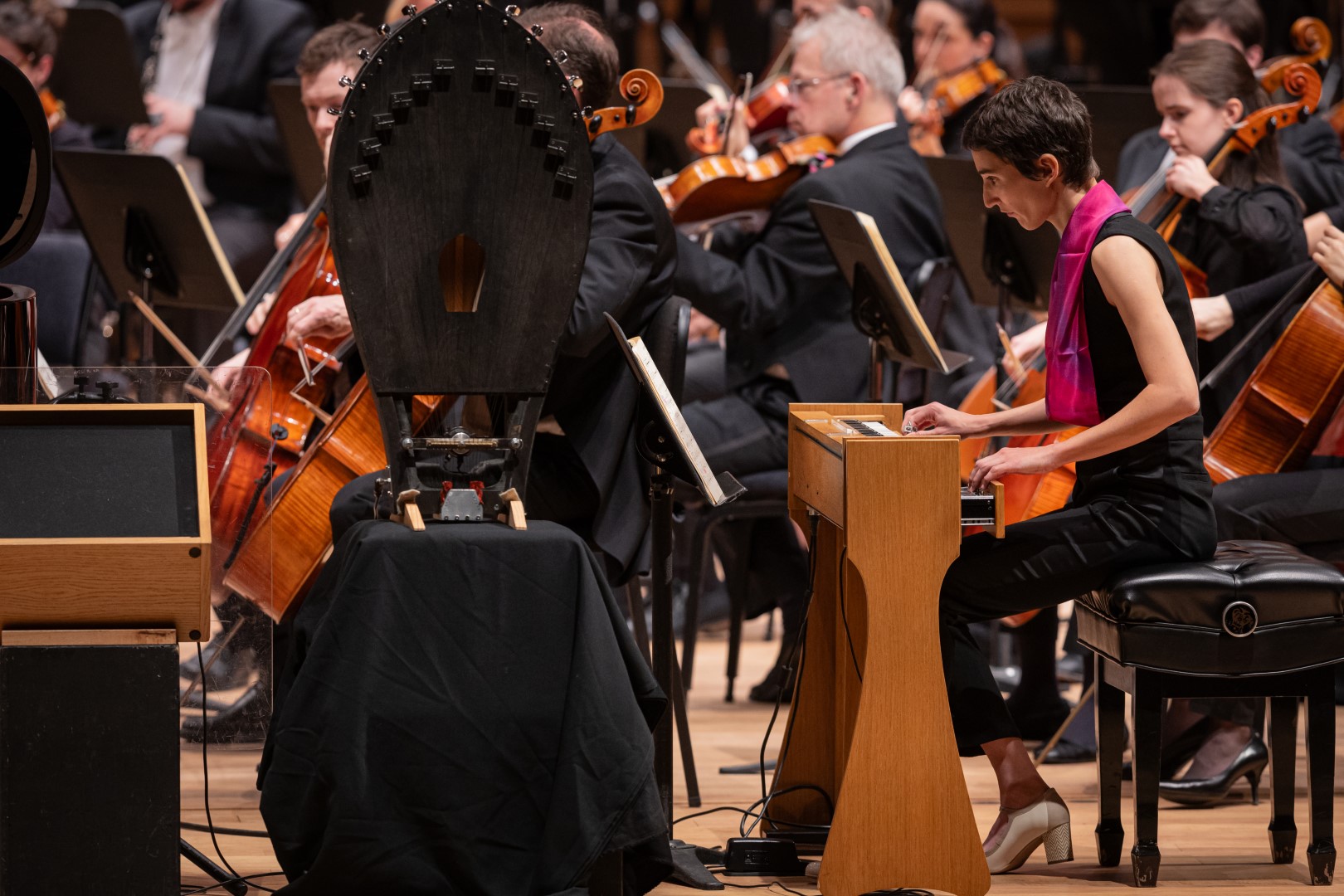 Cécile Lartigau playing the ondes Martenot. Photo credit: Antoine Saito
The result is a pure tone resembling the human voice, similar to that of another electronic instrument, the theramin. Following its invention, the ondes Martenot was primarily used in orchestral compositions, most notably the works of Olivier Messiaen, such as his stunning and impactful 1949 Turangalîla-symphonie. Its widespread use in orchestral music throughout the 20th century is largely due to pioneering ondist Jeanne Loriod, sister–in-law of Messiaen, who was passionate about the instrument's potential and performed all of Messiaen's works for the ondes Martenot.
Despite its orchestral beginnings, the instrument went on to feature prominently in a wide range of musical genres, including popular music such as the work of English rock band Radiohead and songwriter Tom Waits, as well as numerous movie soundtracks including Lawrence of Arabia, Eternal Sunshine of the Spotless Mind, and Amelie. The instrument’s unrivaled uniqueness and flexibility has led to its continued presence in the ever-changing musical landscape, as noted by Lartigau:
‘It is highly evocative, combining mysterious, futuristic, or dreamlike worlds…That magic and uniqueness keep audiences captivated, generation after generation.’
Whether you’re a serial concert-goer or avid playlist listener and you think you’ve heard all the sounds classical music has to offer, perhaps the ondes Martenot will surprise you. Cécile Lartigau will be performing the ondes Martenot in Messiaen's iconic Turangalîla-Symphonie with the Royal Philharmonic Orchestra at the Royal Festival Hall on Thursday 23 April 2026 - you can purchase tickets here:
Turangalîla: Infinite Love at the Royal Festival Hall