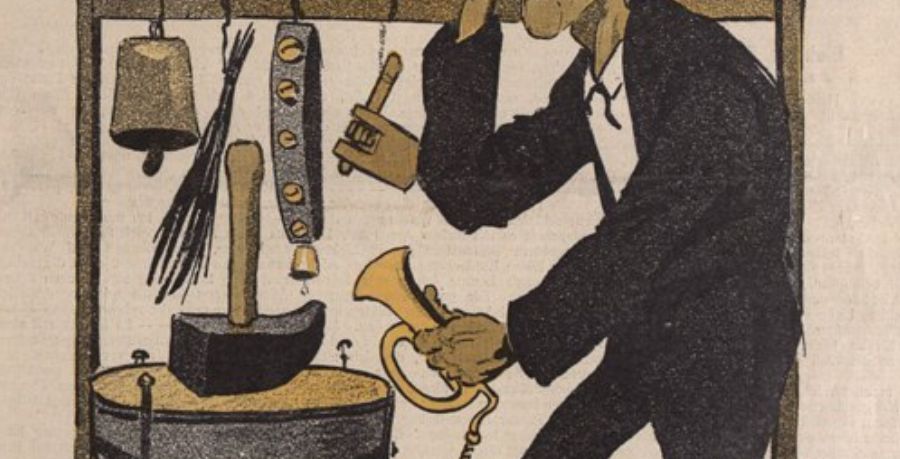
Caricature about the unorthodox usage of a hammer in the symphony, Die Muskete, 19 January 1907
Despite having its premiere nearly 120 years ago in May 1906, it could be said that Gustav Mahler’s Symphony No.6 is rewritten with each live performance.
As is characteristic of his compositions, Mahler’s unusual writing style and sprawling instrumentation make the symphony a challenging feat for orchestras and conductors alike. The work is filled with creative choices that make each interpretation unique, down to the last seconds of the final movement, which is either punctuated by a sudden moment of eerie stillness, or a final, mighty blow of a large hammer wielded by a member of the percussion section.
Mahler wrote his Symphony No.6 during one of the happiest periods of his life, having just married Alma Mahler-Werfel and welcomed the birth of his second daughter. In contrast to the peacefulness of his personal life, however, the piece has some of the darkest themes and most emotionally turbulent sounds of any major symphony. The score is filled with sudden changes in tempo and sound, aided by his unique instrumentation requests, which include offstage cowbells, multiple harps and celestas, deep, untuned bells, and, of course, the unmissable hammer blows. Initial versions of the score even included slapstick and multiple tambourines.
Mahler had initially written five hammer blows into the score, but they were reduced to three for the premiere, and then two in the final, published version of the work. Despite this, many composers such as Leonard Bernstein have opted to include the later-removed third hammer blow, which takes place in the final movement and can be seen as the emotional climax of the work. Alma Mahler-Werfel has quoted her husband as saying that the piece chronicles a hero’s journey, and the three hammer blows are representative of three mighty blows of fate befallen by the hero, ‘the third of which fells him like a tree’.

Origional Mahler 6 score with final hammer blow removed. Credit: Mahler Foundation
In addition to the choice of whether or not to include the third hammer blow, orchestras also vary in their execution of the blows, using a variety of different hammers in an attempt to achieve the desired sound, which Mahler specified in the score as a 'short, powerful, heavy-sounding blow of non-metallic quality, like the stroke of an axe.' A large, wooden mallet on a wooden surface is often used, as are sledgehammers on wood, large bass drums, or a combination of different drums and hammers.
Royal Philharmonic Orchestra Principal Percussion Stephen Quigley remembers one particularly unique hammer used by the Royal Philharmonic Orchestra in the 80’s:
‘The most unusual thing was provided by the conductor Michiyoshi Inoue with whom we made a live Royal Festival Hall recording of the symphony back in 1988. He arrived at the first rehearsal and presented us with a very large & heavy package… it was a large chunk of a Japanese tree, bark still intact, with a long axe handle. For the performance we piled up 3 pieces of RFH stage riser and at the two climaxes I hit these with this chunk of tree, which I’d partially hidden behind the decorative flowers that used to adorn the front of the stage.
Apparently there was a suitably surprised and awed reaction from the audience seated behind me! Inevitably things have moved on and for our concert on March 18th at the Royal Albert Hall I’ll be using a modern piece of equipment: a large wooden box with a sprung membrane fitted in the top, hit with a large purpose shaped mallet.'
Perhaps just as important as the timbre is achieving the desired emotion of the blow, which when done correctly evokes sudden loss, sorrow, and anguish – the shiver of a chill running down the spine.
The Royal Philharmonic Orchestra will be performing Mahler’s Sixth Symphony on Wednesday 18 March at the Royal Albert Hall with our Music Director Vasily Petrenko. As you hear each hammer blow sounded out by Stephen Quigley, start counting – will there be a third final and fatal blow?
It’s the anticipation that gets you.