
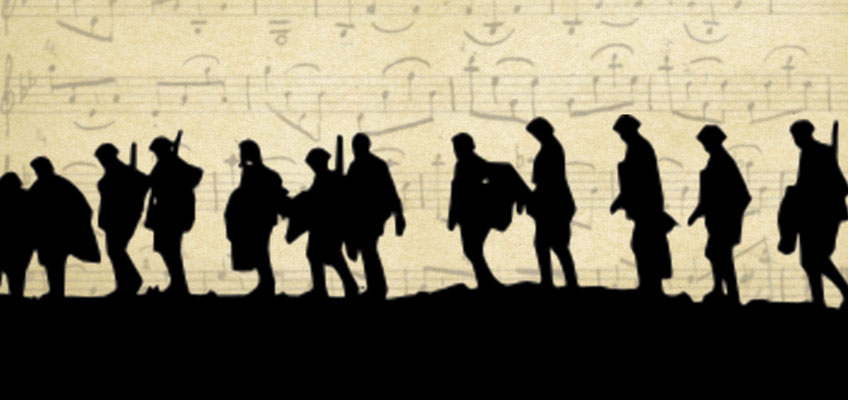
RPO resound’s year of Behind the Lines activities culminates in a four-day creative Summer School this August. Hannah Nepil finds out more.
What was Elgar’s favourite ice cream flavour? And was he ever burgled? These were two of the questions posed by children taking part in Behind the Lines, a year-long education project run by the Royal Philharmonic Orchestra and Westminster Music Library, exploring the music of the First World War. And luckily, Elgar specialist Simon Baggs fielded the answers excellently: whilst there is no documentary evidence about Elgar’s favourite flavour, he could regularly be seen coming out of Woolworths in Worcester with an ice! And he was burgled once, in 1918, by two ex-policemen.
The project began last October, and carries on until summer this year – coinciding with the 100th anniversary of July 1914, when the War broke out. Adults, children and teenagers of all musical skill levels were given the chance to take part in one of several courses running throughout the year, each devoted to a different composer influenced by the events of 1914–1918, among them Elgar, Vaughan Williams, Bliss, Ravel, Ivor Gurney, George Butterworth and Holst.
Although the adult groups did involve practical music making, they tended to focus on discussion of these composers and the themes in their music. The children’s groups, meanwhile, were a little more physically demanding. They would begin with a trip to Westminster Library, where everyone would ‘have a great exploratory time, pulling scores from the shelves, encouraging on-site musicians to read them there and then getting to run round,’ says Ruth Currie, the RPO’s Head of Community and Education. ‘We also had the idea of using the shelving units as ‘trenches’, where people could retreat to come up with ideas.’
Then came a listening and discussion session, in which ‘we would ask the children to imagine what they heard in the music,’ says Detta Danford, who led a Vaughan Williams workshop in June. ‘In the London Symphony, one of them said it sounded like a memorial to somebody. And in The Lark Ascending, someone imagined a man walking out on his own into an icy landscape.’
The final challenge was to create musical responses to the pieces they had heard. ‘We got our children to think about the idea of landscape in Vaughan Williams’ Sinfonia Antartica, Pastoral Symphony and The Lark Ascending,’ says Danford. ‘Then, in our heads, we went on our own musical journey to three different places: the countryside, to the sea and finally to a carnival, using Vaughan Williams’ approach to composition as inspiration.’
As for the ‘war’ element? While the adults were keen to get into the nitty-gritty of what war meant to individual composers, for the children it was more a case of ‘listening to musical devices, such as loud splurges that sound like rifles going off,’ says Currie. ‘Then we’d get them to create their own explosion sound or their own beautiful countryside scene that suddenly dissolves into bloodshed and war. Obviously they grasped onto these ideas quickly. They loved doing it.’
The Behind the Lines Summer School runs 4–7 August 2014. For more details visit: www.musicbehindthelines.org.