
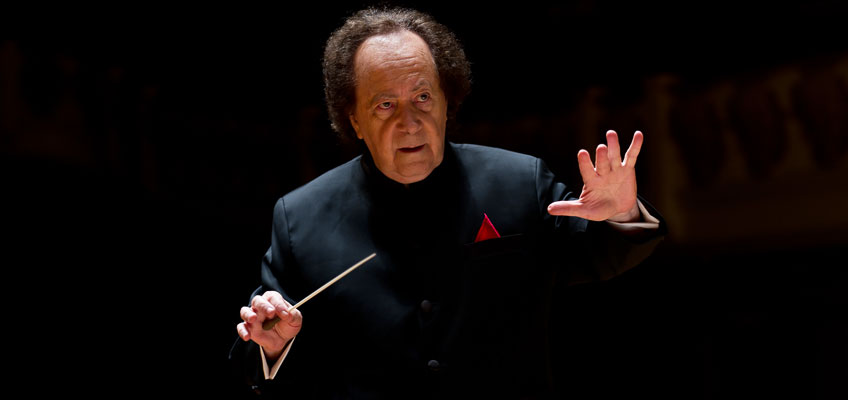
Hollywood comes to the Royal Albert Hall on Wednesday 4 November when the Royal Philharmonic Orchestra performs some of the greatest film scores from the Golden Age of the movies, under the inspired direction of legendary conductor José Serebrier.
It promises to be a match made in tinseltown: the RPO, an orchestra with recording credits including The Bridge on the River Kwai and The Red Shoes, and Serebrier who, in addition to being an acclaimed, multi-Grammy Award-winning conductor famed for his interpretations of Glazunov, has composed for film as well as for one of Hollywood’s biggest stars. He is, therefore, just the man to create more than a little movie magic on this special night.
“My first film score was for The Star-Wagon starring Dustin Hoffman,” he tells me from his home in New York. “We were neighbours and it was just wonderful writing for this young man who, soon after, would become such a big star in his first major film, The Graduate.”
So, solid-gold Hollywood credentials established, what is it about film music that attracts this energetic (he seems far younger than his 76 years) but, otherwise, serious and hugely respected classical conductor?
“The power of the music, pure and simple,” says Serebrier. “Ever since I was a child, I have been fascinated by the power of music to bring a film alive. The best film music has this fantastic ability to create moods and enhance the visual experience.”
It’s a quality that wasn’t lost on some of the greatest composers of the twentieth century, including one of Serebrier’s heroes: Dmitri Shostakovich. Remarkably, he composed almost 40 scores, more than most established film composers manage in a lifetime. Needless to say, Serebrier has recorded many of them.
However, much as he loves the film music of Shostakovich, it is that other Russian composer, Prokofiev, whose film music intrigues him – and one score above all.
“It’s his music for the film Alexander Nevsky,” he says. “The film was directed by Sergei Eisenstein. Unlike today, when composers are given a couple of weeks to compose the score after the film has been shot and edited, Prokofiev and Eisenstein worked on the movie and the music simultaneously – frame by frame, bar by bar. It was unique, and the care and craftsmanship shows. It’s what I mean when I say music brings a film alive.”
Fortunately, audiences will experience exactly that when the conductor directs the RPO in their concert dedicated to the Golden Age of Hollywood. Ben-Hur, Taxi Driver, North by Northwest, Gone With The Wind, Psycho… Movie titles etched in our collective memory – but what do we remember next? The music, of course.
“The mark of a good film score is one that can stand on its own, without the film,” says Serebrier. “The music to these great films absolutely does.”
Among the roll call of great movie composers whose music he and the RPO will be performing is Erich Korngold. According to the conductor, Korngold’s work is proof that great film music, far from being some sort of poor relation of classical music, is a genre in its own right, deserving of equal respect.
“Film music is not a cousin of classical music,” he says. “It is unrelated and, yes, it is functional, there to enhance the film. But, as the music we will perform in the Royal Albert Hall will show, the best scores can stand on their own and stir the emotions as only the greatest music can.”
Written by John Evans