
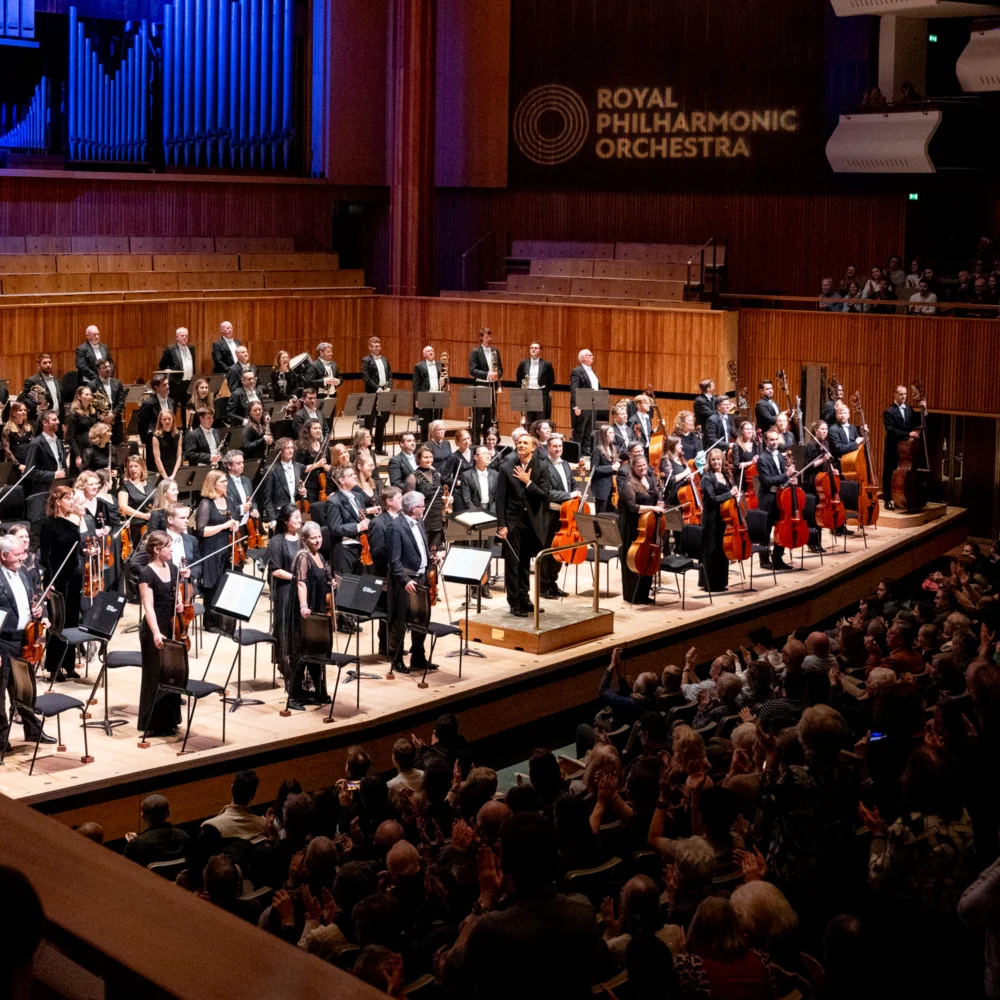

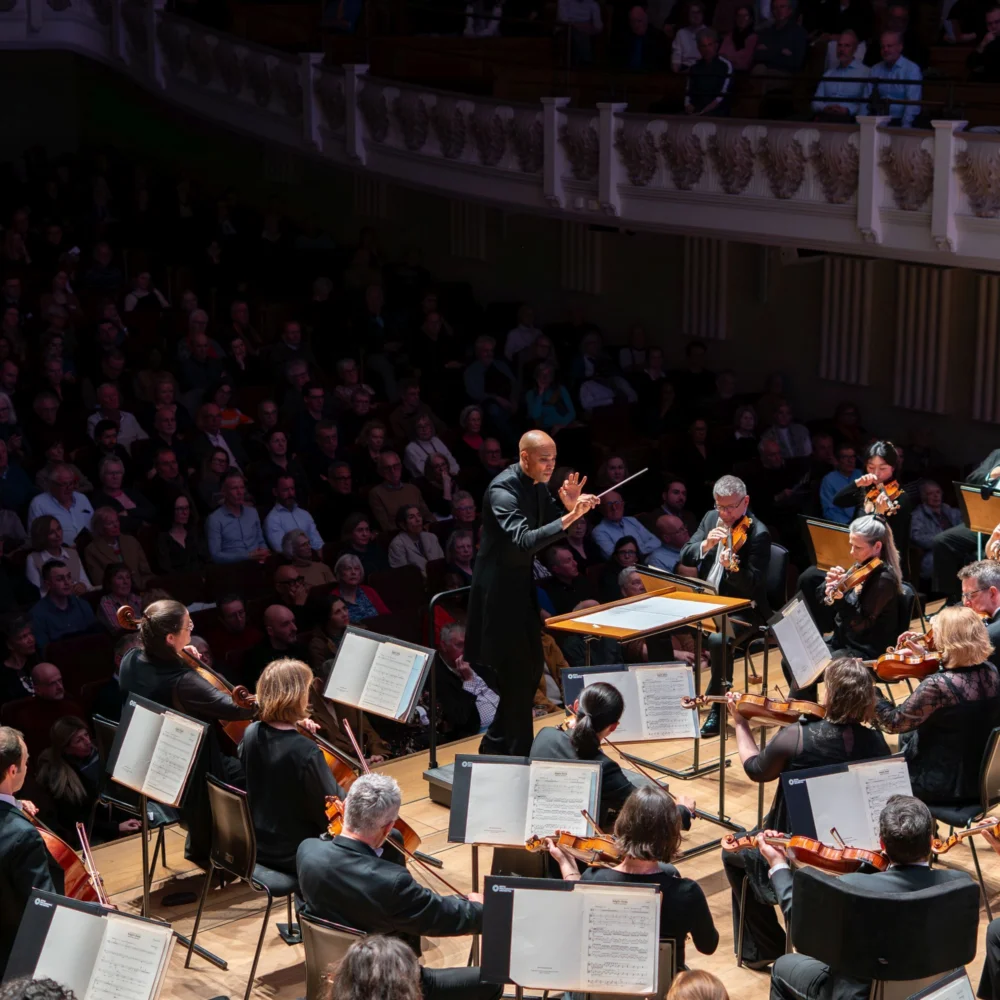


RPO x Vasily Petrenko: More Music to Discover

Credit: Chris Christodoulou
Explore more musical worlds
Want to go beyond the concert programme in our 2025–26 Season? Accompanying our series with Music Director Vasily Petrenko at Southbank Centre and the Royal Albert Hall, our #MoreMusic playlists help you discover music with pieces that defined the lives and journeys of the composers we feature, as well as historical recordings and works by their contemporaries.
Programme notes and listening recommendations by Jo Kirkbride, 2025–2026

Hisaishi x Scriabin
Listen to the playlist
Our season finale of Royal Philharmonic Orchestra x Vasily Petrenko is on Friday 5 June at Southbank Centre's Royal Festival Hall, as we close out 2025–26 with music that reaches into the great beyond.
Opening with Rachmaninoff's Isle of the Dead, this piece was inspired by a black and white reproduction of a painting by Arnold Böcklin of the same name he saw while staying in Paris in 1907. The painter described it as ‘a dream picture: it must produce such a stillness that one would be awed by a knock on the door.’ Rachmaninoff's tone poem draws us into this dream world with the rhythm of beating oars as the boat bearing a mysterious figure approaches the lone island.
Joe Hisaishi's The Border (Concerto for Three Horns and Orchestra) was written at the request of horn player Nobuaki Fukukawa and premiered in Tokyo in February 2020. Inspired by Schumann's Konzertstück for Four Horns and Orchestra, the piece is emblematic of Hisaishi's minimalism, rhythmical playfulness, and individual expressiveness from the solo instruments.
The concert closes with Scriabin's Symphony No.3, 'The Divine Poem'. Premiered in 1905, Scriabin's music had progressively started to loosen off the shackles of conventional Romantic harmonies and structures. His musical development coincided with his deepening philosophical interest in the likes of Schopenhauer, Wagner, and Nietzsche, as well as mysticism and theosophy. It is through these frameworks that he latched onto the concept of divinity being located within each human soul, each desiring to free itself from the material world and become one with the universe. The music he composed later in his life aspired towards this spiritual awakening.
We recommend the music in the above playlist...
Scriabin’s Symphony No.4, ‘The Poem of Ecstasy’ (1908), a single-movement tone poem which follows the path of the spirit as it ascends into a state of consciousness.
Hisaishi’s Harp Concerto (2024), which, like so many of his works, plays with conceptual norms. ‘The harp is usually associated with graceful, gentle, and calm music, but this concerto is intense, wild, and dynamic’. This work hasn't yet been recorded, but the RPO has performed it on tour with Hisaishi with soloist Emmanuel Ceysson. Another inventive piece for soloist and orchestra is his rich and hypnotic Viola Saga, which as been recorded by the Vienna Philharmonic.
Rachmaninoff wrote only four tone poems but The Rock (1893), one of the remaining three, was also inspired by an artistic rendering of a rocky outcrop – in this case a poetic couplet by Russian poet Mikhail Lermontov.
Wagner x Taneyev
Listen to the playlist
On Sunday 17 May we're returning to Southbank Centre's Royal Festival Hall with conductor Vasily Petrenko for a programme full of music that serves the sacred and awe-inspiring.
Opening with the sparkling overture to Mozart's The Magic Flute, this was an opera that was designed to be more accessible to theatre-goers, with more spoken dialogue so the audience could follow along, a leaner orchestration, and less florid and repetition-filled treatment of the libretto. Mozart, a Freemason, also peppered it with references to Masonic symbolism with the number three appearing the structure and modality of the music.
Sergei Taneyev, a relatively unknown composer in the west, was a pupil of Tchaikovsky and Rubinstein, and in turn taught composition to Scriabin, Rachmaninoff and many more. Inspired by the poetry of Alexey Tolstoy, his cantata John of Damascus is a fire-and-brimstone retelling of the life of the eight-century theologian. Often referred to as the 'Russian Bach', Taneyev had a deep interest in the theory of counterpoint, but he was not as prolific a composer as the Baroque composer, only publishing 36 works in his lifetime.
Wagner’s last opera, Parsifal, represented the culmination of his career. Having established his own opera house at Bayreuth and loyal audience, the first public staging in 1882 of the opera, or ‘music drama’, centered around the Arthurian legend of a knight’s quest for the Holy Grail, was as much of a sacred and palingetic ritual as a musical performance: the composer believed that ‘when religion becomes artificial, art has a duty to rescue it.’
We recommend the music in the above playlist...
Mozart’s orchestral Maurerische Trauermusik (1785), or ‘Masonic Funeral Music’, which he composed in honour of two of his Masonic brethren.
Taneyev’s At the Reading of a Psalm (1915) which sits alongside John of Damascus as one of his only two published cantatas, and is also his last known work.
Like Parsifal, most of Wagner’s operas are so long that they resist being abridged for the concert platform, but the Prelude and Liebestod from Tristan und Isolde (1865) is one of the most successful introductions to his operas.
Mahler x Korngold
Listen to the playlist
On Tuesday 12 May we'll be performing Mahler's Symphony No.5 and Korngold's Violin Concerto, featuring soloist Ray Chen, at the Royal Albert Hall under the baton of Vasily Petrenko.
Like Mahler, Korngold was a child prodigy who went on to make his name in the opera house. His international success as a composer and conductor after Die tote Stadt came under the shadow of the Nazi's rise to power in 1933, and, being from a Jewish family, he took the opportunity to live to Hollywood when he accepted a commission in 1934 to work on the score of renowned director Max Rheinhardt's A Midsummer Night's Dream. Although he continued to conduct operas in Austria, another commission in 1938 to compose the score for The Adventures for Robin Hood presented him with another opportunity to escape just as the country was annexed and his home in Vienna seized. Korngold's Violin Concerto, premiered in 1947 by the legendary Jascha Heifetz, incorporates many themes and musical ideas from the many film scores he'd composed during his time in the US, and his other post-war concert works also blends the worlds of film and classical.
Mahler made a return to purely orchestral writing with his Fifth Symphony, eschewing choirs and female voices he had used in his Second, Third and Fourth. It also marked a new chapter in his life, as in February 1901 he suffered a brain hemorrhage that nearly claimed his life, and later that year he met the composer and socialite Alma Schindler, with whom he fell madly in love. Completed in 1902, the funereal first movement and stormy second movement give way to a lighter scherzo and then a deeply affective Adagietto for strings and harp - a love song to Alma.
Discover more music related to the programme in the above playlist.
Korngold’s Cello Concerto in C major (1950), which was expanded from the score for the 1946 Bette Davis film Deception.
Korngold’s Symphony in F-sharp major (1952), the only symphony he wrote in his entire career, which incorporates music from his score for the 1939 film The Private Lives of Elizabeth and Essex.
Bruckner’s own Fifth Symphony (1876), which Mahler has been conducting the same day he had his brush with death in February 1901.
Mahler 6
Listen to the playlist
Wednesday 18 March sees our return to the Royal Albert Hall as our series of Mahler symphonies continues under the direction of Vasily Petrenko with the Sixth. Sometimes known as the ‘Tragic’, it is widely regarded as the darkest, most nihilistic, unwaveringly bleak symphony in Mahler’s output – yet it was composed, perhaps inexplicably, during one of the happiest periods of his life. But everything was to change within a year of the Symphony’s premiere, when Mahler suffered three consecutive personal blows. In the spring of 1907, rising antisemitism lost him his job as the Director of the Vienna Opera, and in the summer both his daughters fell ill with scarlet fever and diphtheria, and one did not survive. Just weeks after his daughter’s death, Mahler was diagnosed with a debilitating heart condition – it would kill him in 1911. The thunderous hammer blows that appear at the end of the fourth movement became tragically prophetic.
Discover more music by Mahler and other symphonic expressions of darkness, loss and fate in this playlist.
Mahler’s Kindertotenlieder (1901–4), his song cycle on texts by Friedrich Rückert, which was composed at the same time as the Sixth Symphony. Mahler quotes the first song, Nun will die Sonn’ so hell aufgehn, in the Symphony’s Andante.
Shostakovich’s own Sixth Symphony (1939), with its equally grotesque funeral march in the opening movement.
Schubert’s Symphony No.4 in C minor, ‘Tragic’ (1816), composed nearly a century earlier and so-named by the composer himself, likely because it was his first symphony in a minor key.
Shostakovich x Beethoven
Listen to the playlist
Our 2025–26 Season with Vasily Petrenko continues on Tuesday 3 February with music by Galina Ustvolskaya, Beethoven and Shostakovich. As Ustvolskaya's tutor at the Leningrad Conservatory, Shostakovich considered her skill as a composer to be even greater than his. As we perform her Dream of Stepan Razin and Shostakovich's Symphony No.10, together, their music tells a story of political oppression and personal defiance, both refusing to be cowed by a regime that was determined to quash personal expression. Between pieces by these two Soviet composers is Beethoven's First Piano Concerto, the product of a fiery young composer who was hell-bent on re-writing the rules of the form.
Eager to hear more by these composers? Discover more of their music in this playlist.
For a glimpse into Ustvolskaya’s more extreme, brutal style, try her Symphony No.2, ‘True and Eternal Bliss!’ (1979).
Although Beethoven himself told his publisher it was ‘not one of my best’, his smaller Piano Concerto No.2, composed before his Piano Concerto No.1, shows how quickly his concerto style evolved into a more adventurous form of writing.
Shostakovich’s String Quartet No.5 (1952), which was composed a year before the Tenth Symphony, and is almost a partner piece in its anticipation of the Symphony’s raw, emotional landscape.
Mahler x Bernstein
Listen to the playlist
The opening concert of our 2025–26 Season sees the first instance of our three performances of Mahler's symphonies this season. Mahler's Symphony No.1, 'Titan', is a voyage through life and death, birdsong and fanfares, funeral marches and Viennese waltzes, written by a composer who would bring the syphonic form to its pinnacle in the early twentieth century, and who lived out his last years in the United States. Few other American musicians are as instantly recognisable as Leonard Bernstein in style, who was a lifelong champion and populariser of Mahler, and whose Chichester Psalms give choirs the challenge of singing psalms in the original Hebrew.
Discover more music by these composers in our playlist.
Wagner’s opera Lohengrin: listen to the Prelude to Act I for the parallels with (perhaps even plagiarism of) Puccini’s Prelude sinfonico.
Bernstein’s Symphony No.3, ‘Kaddish’, completed just two years before the Chichester Psalms, is a lavish choral symphony that is also centred around Hebrew texts.
Mahler’s song cycle, Lieder eines fahrenden Gesellen (Songs of a Wayfarer), whose material weaves its way through his First Symphony.
Programme notes and listening recommendations by Jo Kirkbride, 2025/2026
Discover more
Explore the stories behind the music


