



Five stars for Messiaen’s Turangalîla at the Multitudes Festival

Credit: Andy Paradise
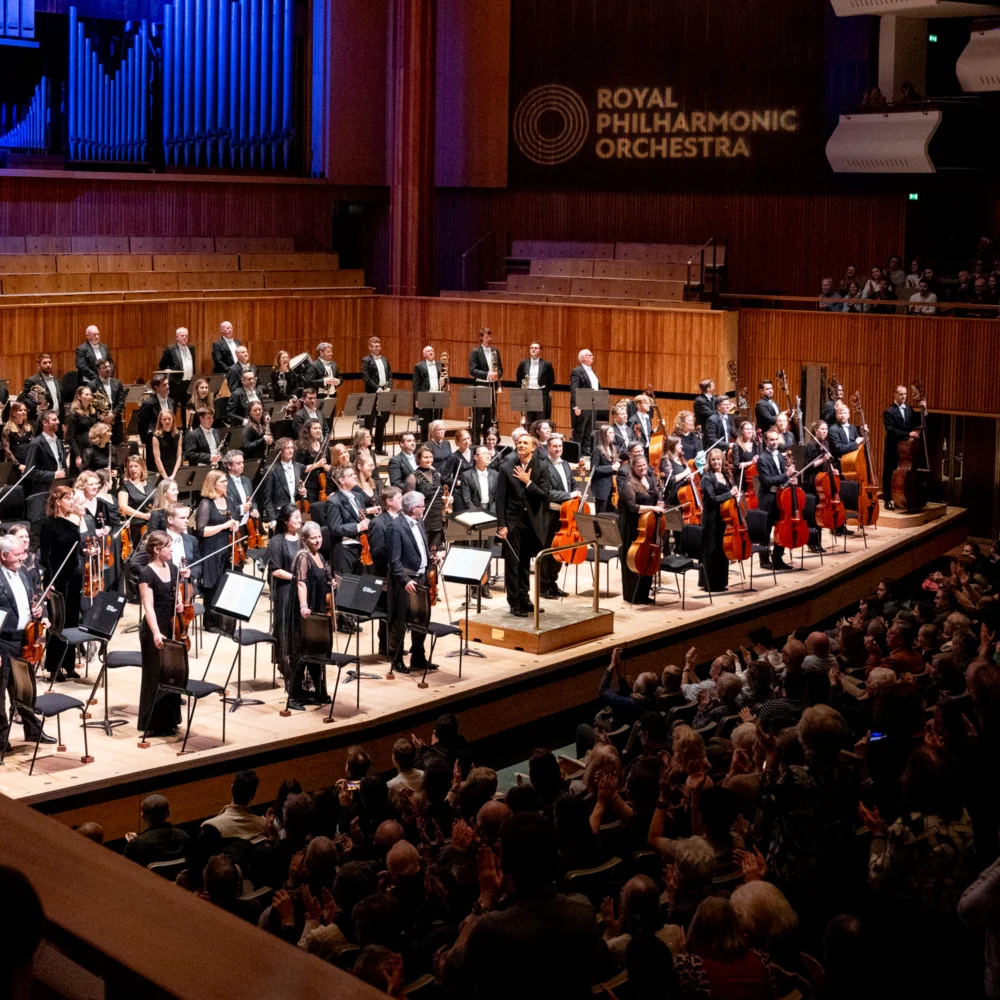
On Thursday 23 April we returned to the Royal Festival Hall to take part in Southbank Centre’s Multitudes, a festival that paired different art forms with orchestral music.
Our performance of Olivier Messiaen’s mind-bending and kaleidoscopic Turangalîla-Symphonie was accompanied by a film produced by 1927 Studios and Judith Dimant Productions. Inspired by the golden age of silent film, it told the story of a love that overcomes death between a knight and a cruel king’s bride-to-be in the vein of Wagner’s opera Tristan und Isolde, the music of which served as an inspiration for Messiaen.
“The RPO’s inspired collaboration with the multi-award-winning 1927 Studios was a triumph.”


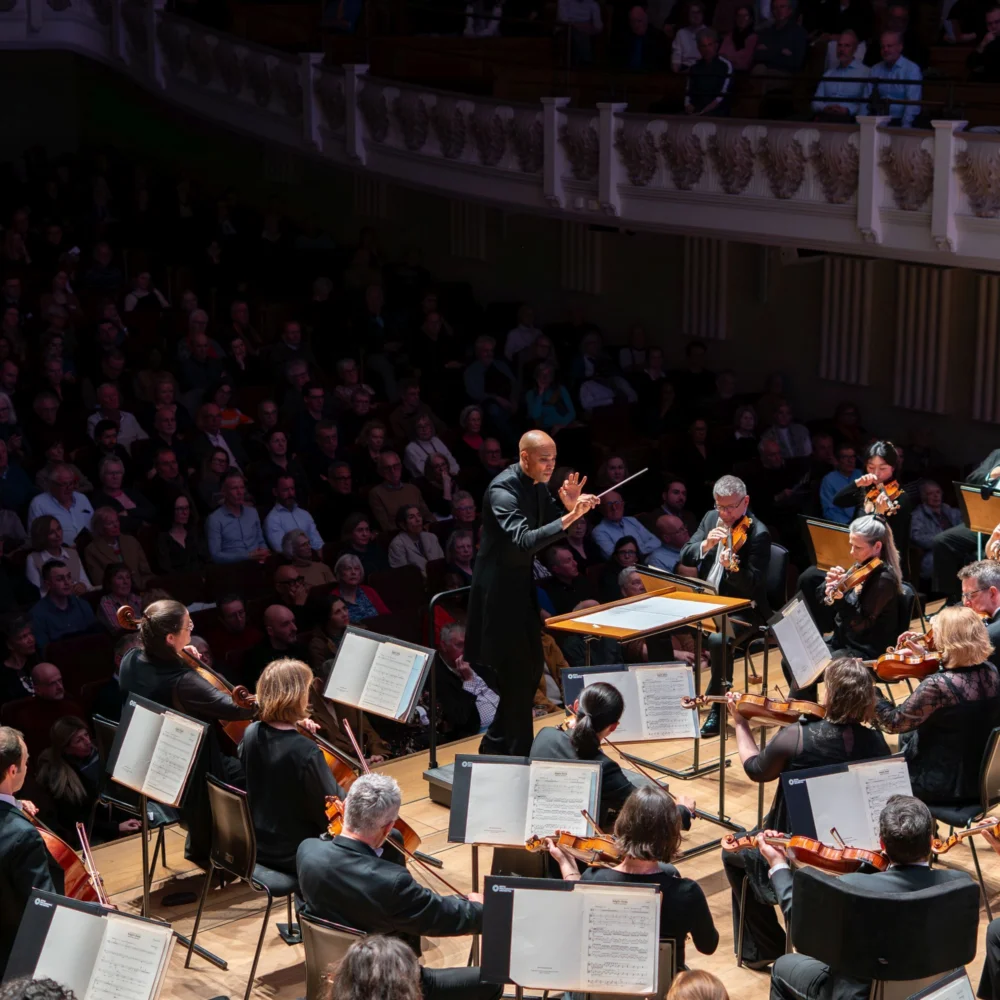
Conducted by our Music Director, Vasily Petrenko, the substantial orchestral forces on stage were joined by soloists Steven Osborne OBE, who executed Messiaen’s fiendishly difficult piano part with precision and finesse, and ondes Martenot player Cécile Lartigau.
Messiaen frequently wrote music for this early twentieth-century instrument, which produces an otherworldly, ethereal sound through electrical oscillations, the timbre of which can change depending on the shape and material of the speaker that is connected to the wire and keyboard.


More reviews
The film starred Jake Cecil as The Knight, Esme Appleton as The Bride, Ben Whitehead as The Knave, Bruno Pearson as The King, Suzanne Andrade as The Alchemist, and Will Close as The Vicar.
'...a love song, a hymn to joy, love that is fatal, irresistible, transcending everything, suppressing everything outside; joy that is superhuman, overwhelming, blinding, unlimited.' - Olivier Messiaen
Messiaen’s cosmic and ecstatic work was borne from a commission by Serge Koussevitzky, music director of the Boston Symphony Orchestra. The title Turangalîla is a compound word derived from two Sanskrit words: ‘turanga’ (rhythm) and ‘lîla’ (play). In the composer’s words, it is ‘play in the sense of the divine action upon the cosmos, the play of creation, destruction, reconstruction, the play of life and death’, which then combines with the rhythms of time and the universe themselves to produce the grand narrative Messiaen envisioned.
Inspired by the French legend of the fateful love of Tristan and Isolde, which was incorporated into Arthurian canon by the thirteenth century, Messiaen’s piece brings torrid and electric feelings stirred by an all-consuming love to dizzying heights over the course of its ten movements.
A champion of Messiaen’s music, Serge Koussevitzky's hopes to conduct the premiere were dashed by ill health, but the baton was picked up by a young Leonard Bernstein, who led the premiere in Boston’s Symphony Hall in 1949. He was never to conduct the piece again in his career.

Thank you to everyone who joined us. We’ll be back at the Royal Festival Hall with Vasily Petrenko on Sunday 17 May for music from Wagner’s Parsifal, Mozart's The Magic Flute, and Taneyev’s cantata John of Damascus with the Philharmonia Chorus.
Related events
Our upcoming concerts at Southbank Centre

