



Adam Hickox: Conductor-in-Residence, 2026–27
Conductor-in-Residence, 2026–27

Credit: Ben Ealovega
About Adam Hickox
Conductor-in-Residence, 2026–27 at Cadogan Hall
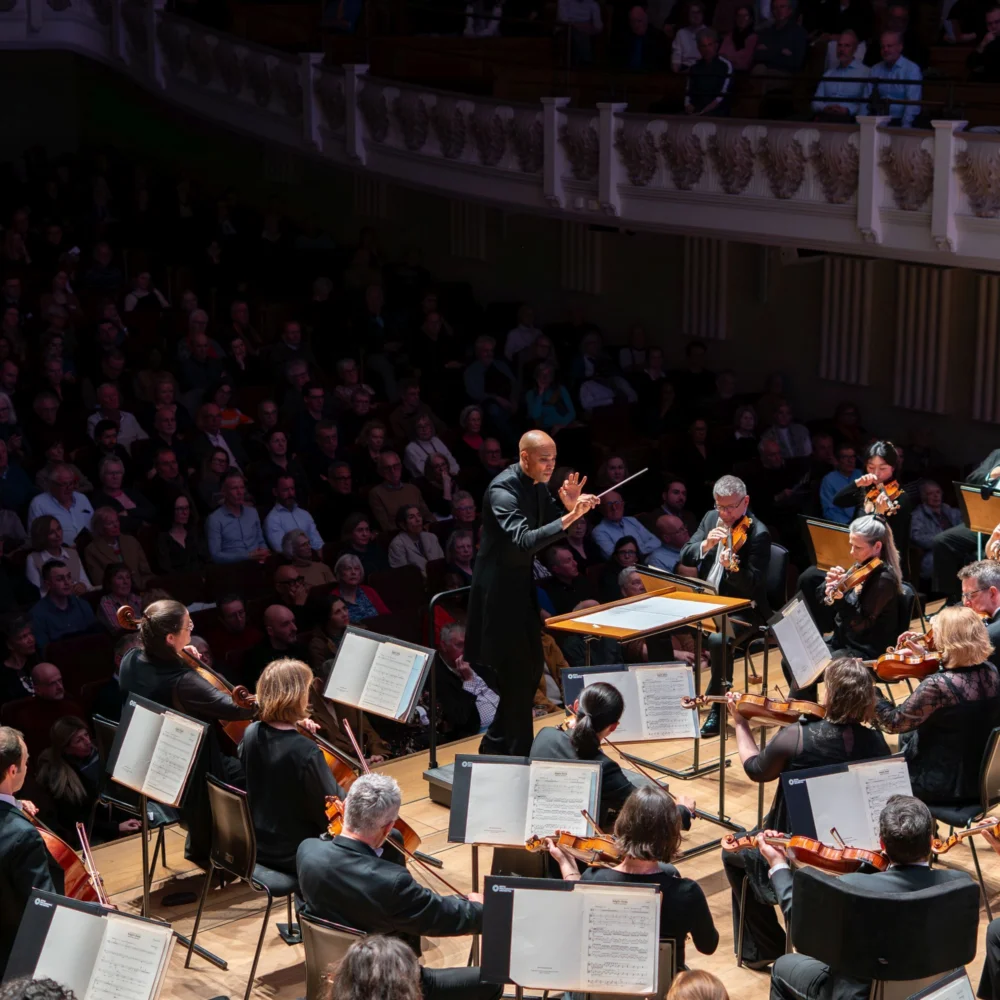
British conductor Adam Hickox is praised repeatedly for his masterful and expressive interpretations and is in increasing demand across the world both on the concert platform and in the opera house. In September 2025, he took up his position of Chief Conductor of the Trondheim Symphony Orchestra. He continues his tenure as Principal Conductor of The Glyndebourne Sinfonia and across the 2025–26 Season, he makes several major debuts. For the 2026–27 Season, he will conduct the Royal Philharmonic Orchestra for three concerts at Cadogan Hall as the RPO’s Conductor-in-Residence.
Season highlights include his debuts with the Dresden Staatskapelle, Frankfurt Radio Symphony, Hamburg Symphony, Oslo Philharmonic and Tokyo Symphony orchestras. Return guest engagements include the Deutsche Symphonie-Orchester Berlin, Philharmonia, Royal Philharmonic, Royal Liverpool Philharmonic and BBC Philharmonic orchestras.
Adam is equally committed to the opera house and in the 2025–26 Season, he will make his debut at Dutch National Opera conducting Weinberg’s The Passenger. He conducted Floris Visser’s production of La bohème at Glyndebourne in autumn 2025.
Adam studied music and composition with Robin Holloway at Gonville and Caius College, University of Cambridge, and conducting with Sian Edwards at the Royal Academy of Music. He was Assistant Conductor of the Rotterdam Philharmonic Orchestra from 2019 to 2022 working closely with Lahav Shani, and in 2021 he was invited to Tanglewood as one of the Festival’s two Conducting Fellows.
How would you describe your artistic relationship with the Orchestra, and how do you hope it develops across the season?
The RPO is a wonderful orchestra – I feel an ease of communication with them that has meant that we have been able to create compelling artistic results in what have often been very short timeframes. They are remarkable in the speed at which they assimilate scores and deliver the great orchestral repertoire. Having worked with the Orchestra many times since my debut in 2023, I’ve developed a personal rapport with a lot of the players which means a great deal to me – when that level of trust is afforded to you as a conductor, you can immediately go beyond simply executing details and find a greater depth in performances.
What first drew you to conducting, and what continues to inspire you about the role today?
As soon as I fell in love with music (around the age of 10), I was drawn to conducting. I think there is something about the combining of music with gesture that drew me in, and music’s ability to stir people emotionally, in a way that very little else can, was really like an electric shock to my system. I have never really looked back from that moment – and I see my role as one that combines enabling others to give their very best whilst advocating for the intentions and wishes of the composer.
The ‘Ode to Joy’ theme from Beethoven’s Ninth Symphony is one of the most recognisable melodies in classical music, but the work contains so many remarkable moments. Are there any particular passages you especially love or think audiences should listen out for?
The coda to the first movement of Beethoven’s Ninth [Thursday 22 April 2027] is something that has always inspired me. The chromatic-inflected bass line starts as a subterranean accompaniment before rising upwards in the orchestra to the violins – in a sequence that builds with almost unbearable tension – until we are presented with a final, emphatic rendition of the main theme.

Adam Hickox
'I see my role as one that combines enabling others to give their very best whilst advocating for the intentions and wishes of the composer.'
This season you collaborate with Liya Petrova in Sibelius’ Violin Concerto. What makes this concerto such a compelling work for both soloist and orchestra?
As always with Sibelius [Thursday 8 October 2026], you are immediately transported to the landscape of his native Finland – the Concerto’s opening presents a string texture that sends icy shivers down one’s spine. What follows, however, is at times some of the most ravishing music that he ever wrote, with a solo part that is at once introspective and virtuosic.
For Tchaikovsky Revealed you explore Tchaikovsky’s Symphony No.4 with presenter Leah Broad. What makes this symphony such a compelling work to unpack for audiences?
Whilst Tchaikovsky’s first three symphonies are masterworks in their own right, the Fourth [Wednesday 19 May 2027] represents something of a turning point in his work as a symphonist. The first movement contains an obsessive rhythmic vitality that ends with such intensity that it leaves little room to breathe. But the second movement presents a contrasting lyricism, unsurprising given that the work was largely written in Italy. The Scherzo is particularly memorable in its inventive use of pizzicato, and the finale, a kind of Russian folk-celebration, brings the work to an unforgettable close.
What do you hope audiences experience when they come to hear the Royal Philharmonic Orchestra at Cadogan Hall this season?
I hope that audiences can be drawn into a world where nothing else exists but the music that is being presented to them in the moment. We want to offer you performances of the highest level, and to give you an opportunity to savour the rich and beautiful sound of the RPO.
Don’t miss Adam’s performances
Add these shows to your must-see list


Read more
Discover our new Revealed concerts at Cadogan Hall
